Tuesday, 25 May 2010

Philip Lorcia diCorcia


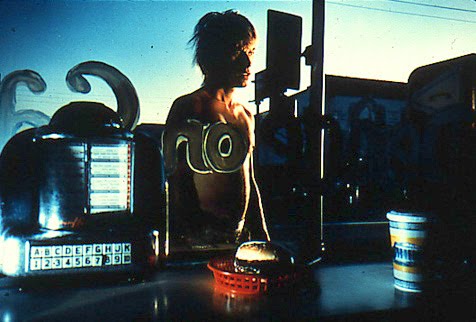
Ever since having learned about Philip Lorcia diCorcia, I have been amazed by his work. He has an excellent talent in staging photographs and making them look believable. His main area of photography is tableau, which is highly staged and perfectly executed in every way. Most of his images have a very sinister look and feel to it. Hollywood was his most famous and impressive piece of work to me and I really do aspire to reach such a level of artistic photography. In the creation of this work he asked male hookers and drug addicts to pose for him and payed them a certain amount, which he always displayed with the resulting photograph.


Source: www.artscenecal.com; Museum of Modern Art, Philip-Lorcia diCorcia

Nan Goldin


Nan Goldin became famous with works such as The Ballad of Sexual Dependency and A Double Life.
Although her work is highly regarded and spoken of, I feel that there is a certain madness to it, with a lot of obscene and disturbing content.This madness can also be seen in images which do not contain much nudity, where the interaction or also the lack of it between people in her images.
It might be argued that Nan Goldin is not a photographer, she uses photography as an artistic medium in a very well executed way. Compositions and exposures are placed where they can make a viewer come back to look at her images over and over again. Despite this, her work is something to me that I look at once and then move on.


Source: www.photography-now.com; www.tate.org.uk

Stephen Shore


I personally like to think of Stephen Shore as the master of colour photography. He was photography's pioneer in the area of colour film. Although he also used black and white film he certainly changed how photography was seen by artistically creating images on colour film, often using large and middle format equipment to maximize image quality.
His most important work was A Road Trip Journal, for which, as he himself said, started photographing everything around him and even after coming back from his road trip through the USA still carried on taking pictures of everything around him.


Source: www.artcyclopedia.com; www.masters-of-photography.com

Thursday, 29 April 2010

Robert Frank


Robert Frank is generally best known for his work "The Americans", for which he traveled to several places in the USA with the intention to show cultural and racial differences within the country as well as differences to other world countries. Although his book was highly criticized when released in the USA, it later became one of the most influential contemporary art works and is still being seen as a historical reference today.
Despite all the criticism I very much enjoy most of his work, because of the thought through composition and use of black and white film. The opening image of this post is a perfect example. Having left just enough space to show relevant elements within the image, but at the same time providing the viewer with space at the edges to really think about what could be happening, makes this photograph grab the viewer's attention in a very positive way.


Sources: http://www.telegraph.co.uk; Steidl, The Americans

Thursday, 25 February 2010

The Story Book Wolf


This blog is written as part of my current Discourse class at UEL. Over the next few weeks I will be writing on topics such as Modernism, Feminism and Capitalism within Photography. I will also be writing about other topics related to photography, including several biographies of photographers who have influenced and changed the way we see photography today.

To start off I will use this space to write briefly about the recent disqualification of the winner of the Wildlife Photographer of the Year contest.
In October 2009 the judges of the competition panel chose Jose Luis Rodriguez's picture "The Storybook Wolf" from over 43,000 entries to be the winning image. It was only several months later and after exhibitions had displayed the winner and merchandise was sold, that Jose was stripped of his winning title.
Several investigations were conducted and the judges ultimately came to the conclusion, that he had "hired" a tamed wolf from a zoological park in Madrid. According to Mark Carwardine this was the first time in 46 years that there was no winner. The picture was removed from the exhibition and the photographer was banned from entering the competition ever again.

Although The Storybook Wolf is a well executed photograph, there is no question that the photographer clearly failed to follow the competition rules and as such it is more than deserved for his title to be removed.